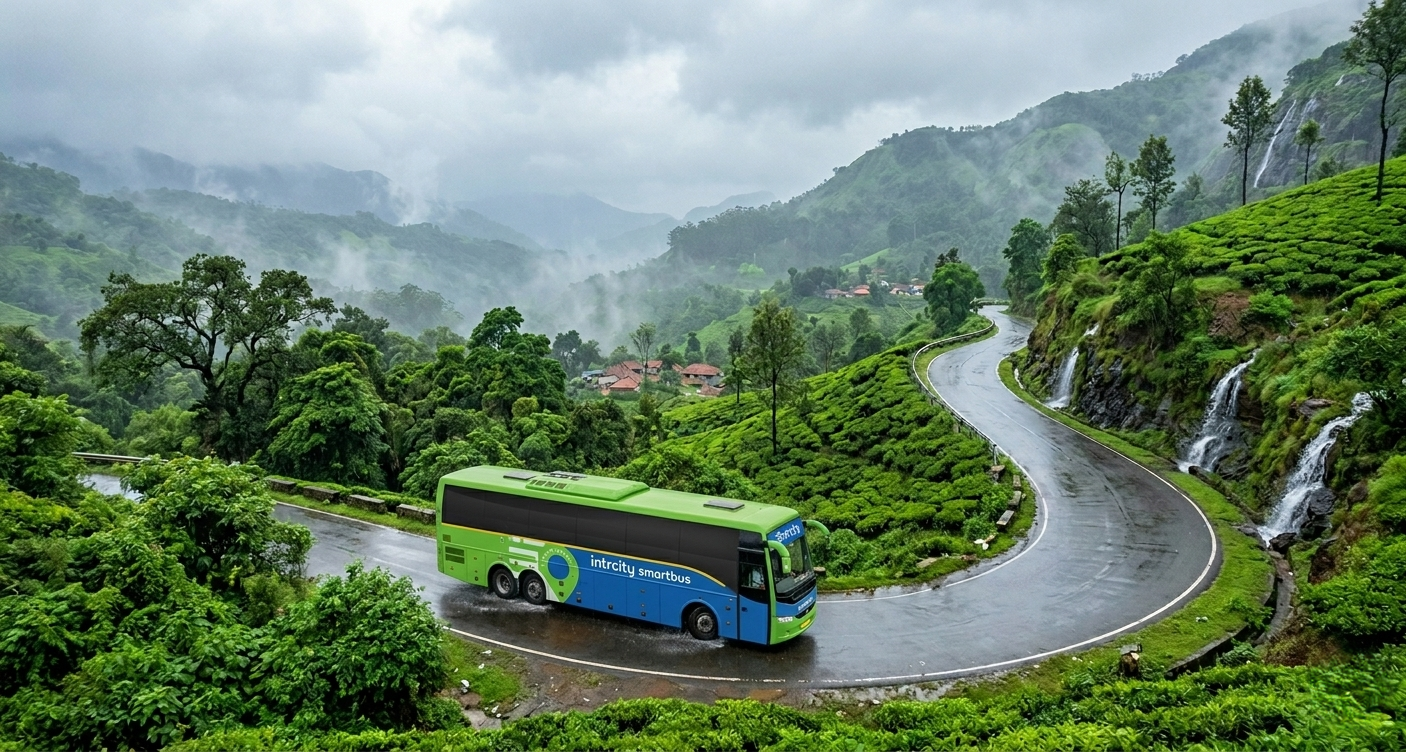

The best monsoon destinations in India are not just beautiful. They are genuinely better in the rain. Waterfalls that barely exist in April become thundering walls of water. Dry hillsides turn into shades of green you simply do not see on any other season’s postcard. Hill stations empty out. Beaches go quiet. And the air smells different — cooler, greener, more alive.
This guide is specifically about places you can reach comfortably by bus. No flights, no layovers, no expensive last-minute train bookings. Whether you are planning a 3-day family trip, a weekend escape with your partner, or a solo offbeat adventure, there is a destination here worth the ride. Most of these routes run directly from Delhi, Mumbai, Bangalore, or Chennai. Some are under 200 km. Some take an overnight journey and you wake up to clouds and coffee.
Here are 10 monsoon destinations across India — and exactly how to get there by bus.
1. Coorg, Karnataka
Why go in monsoon: Coorg in the rains is a different world. The coffee estates turn a deep, glistening green. The Abbey Falls and Iruppu Falls hit their peak flow. And the mist that rolls in every morning makes the entire hill station feel like it’s been wrapped in gauze.
Getting there: The Bangalore to Coorg bus is one of the most popular weekend routes in South India. Multiple operators including IntrCity SmartBus run overnight and early morning services from Bangalore’s Majestic and Silk Board boarding points. Journey time is approximately 5–6 hours.
Best for: Coffee estate stays, waterfall treks, bird watching in Nagarhole.
2. Munnar, Kerala
Why go in monsoon: Kerala’s monsoon is legendary — and Munnar sits right in the middle of it. The tea gardens absorb the rain and reflect it back in every shade of green imaginable. Waterfalls appear on every hillside. Visitors who come here in July or August often say it’s the most beautiful place they’ve ever seen.
Getting there: Well-connected by bus from Kochi, Coimbatore, and Bangalore. The Kochi to Munnar route is around 3.5–4 hours and has frequent services throughout the day. From Bangalore, overnight options are available with AC coaches.
Best for: Tea estate walks, Eravikulam National Park (if open), Attukal and Lakkam waterfalls.
3. Cherrapunji (Sohra), Meghalaya
Why go in monsoon: Cherrapunji is literally one of the wettest places on earth — and monsoon is when it earns that title. The Nohkalikai Falls, the highest plunge waterfall in India, reaches its most breathtaking volume in July and August. Living root bridges disappear into a canopy of dripping green.
Getting there: Fly into Guwahati or Shillong, then take a local bus or shared cab to Cherrapunji. State transport buses run regularly between Shillong and Sohra (about 2 hours), making it an easy add-on to a Northeast India trip.
Best for: Nohkalikai Falls, double-decker root bridges in Nongriat, Mawsmai Cave.
4. Lonavala & Khandala, Maharashtra
Why go in monsoon: Only a couple of hours from Mumbai and Pune, Lonavala becomes a completely different destination when it rains. The Bhushi Dam overflows, the valleys fill with waterfalls, and the famous Tiger’s Leap viewpoint lives up to its reputation when clouds drift through the gorge below.
Getting there: One of the best-served bus routes in India. Dozens of buses run daily between Mumbai and Lonavala (2–2.5 hours) and Pune and Lonavala (1–1.5 hours). Volvo AC coaches and IntrCity SmartBus services make this a genuinely comfortable ride. A great route for a quick bus ticket booking online and a spontaneous weekend escape.
Best for: Bhushi Dam, Tiger’s Leap, Rajmachi Fort trek, chikki and corn on misty roadsides.
5. Mahabaleshwar, Maharashtra
Why go in monsoon: Maharashtra’s most beloved hill station gets over 6,000 mm of rainfall annually — and it shows. The strawberry farms, the dense Sahyadri forest, and the dramatic viewpoints like Arthur’s Seat and Wilson Point are at their most alive during the rains. The town itself quietens down (many hotels close for peak monsoon), making it ideal for solitude-seekers.
Getting there: Regular buses run from Mumbai (approximately 5 hours) and Pune (approximately 3.5 hours) to Mahabaleshwar. AC and semi-sleeper coaches are available. The road itself, winding through the Sahyadris, is spectacular in the rain.
Best for: Arthur’s Seat viewpoint, Venna Lake, Lingmala Waterfall, strawberry farms.
6. Gokarna, Karnataka
Why go in monsoon: Goa gets all the attention, but Gokarna in the monsoon is the better-kept secret. The crowds that descend in winter simply don’t come between July and September. The beaches — Om Beach, Half Moon, Paradise — are wild, powerful, and nearly empty. The small temple town itself slows to a meditative pace.
Getting there: Gokarna is well-connected by bus from Bangalore (approximately 8–9 hours overnight), Mangalore (3–4 hours), and Hubli (2.5–3 hours). IntrCity SmartBus runs services on the Bangalore corridor with sleeper and seater options.
Best for: Om Beach, Mahabaleshwar Temple, sunset cliff walks, off-season solitude.
7. Wayanad, Kerala
Why go in monsoon: Wayanad’s wildlife, waterfalls, and tribal heritage are best experienced when the forest is in full bloom. Soochipara Falls and Meenmutty Falls are at peak volume, the Banasura Sagar Dam fills to the brim, and the forest canopy becomes impossibly lush. It’s also one of the most ecologically active periods for bird and wildlife sightings.
Getting there: Easily accessible by bus from Kozhikode (Calicut), Bangalore, and Mysore. The Bangalore to Wayanad overnight bus takes approximately 7–8 hours. Mysore to Wayanad is around 3–4 hours by road and is one of the most scenic highway drives in South India.
Best for: Soochipara and Meenmutty Falls, Chembra Peak trek, Edakkal Caves, bamboo forests.
8. Spiti Valley, Himachal Pradesh
Why go in monsoon: Counterintuitive but true — while most of India gets drenched, Spiti sits in a rain shadow and stays surprisingly dry. July and August are actually among the best months to visit this high-altitude cold desert. The passes are open, the roads are accessible, and the ancient monasteries of Kaza, Tabo, and Dhankar are at their most reachable.
Getting there: The Manali to Kaza bus is a legendary route — 8 to 10 hours through some of the highest motorable roads in the world. From Shimla, the Hindustan-Tibet road via Nako takes longer but is equally dramatic. Book your bus tickets to Manali or Shimla first, then connect onward.
Best for: Chandratal Lake, Key Monastery, Pin Valley National Park, fossil-hunting near Langza.
9. Pondicherry, Tamil Nadu
Why go in monsoon: Most travellers skip Pondicherry in the rains, which is precisely the reason to go. The French Quarter empties of tourists, the promenade is dramatic and windswept, and the cafés — Villa Shanti, Le Café, Café des Arts — are at their most atmospheric when it’s pouring outside. The sea is rough and beautiful.
Getting there: The Bangalore to Pondicherry bus is one of IntrCity SmartBus’s most-travelled routes. Overnight coaches depart from Bangalore’s Electronic City and Silk Board, arriving in Pondicherry in approximately 6–7 hours. Chennai to Pondicherry is a short 3-hour ride with frequent daily services.
Best for: Rainy promenade walks, Auroville, seafood, boutique shopping, off-peak café culture.
10. Kasauli, Himachal Pradesh
Why go in monsoon: While Shimla and Manali get packed even in the rains, Kasauli stays quietly beautiful and relatively crowd-free. This small colonial-era hill station, just 65 km from Chandigarh, has neat stone churches, pine-scented walks, and a British-era brewery that’s worth a visit. The monsoon brings fog, cool temperatures, and a storybook stillness.
Getting there: Kasauli is best reached via Chandigarh or Kalka. Regular buses run from Delhi to Chandigarh (approximately 5 hours) with multiple daily departures including Volvo AC coaches. From Chandigarh, local buses and cabs connect to Kasauli in about 1.5 hours.
Best for: Gilbert Trail, Monkey Point, Kasauli Brewery, Mall Road, quiet mountain walks.
How to Make the Most of Bus Travel This Monsoon
Long-distance bus travel in the monsoon is genuinely comfortable when you pick the right operator and plan ahead. A few tips:
Book early. Monsoon weekends — especially long weekends in July and August — fill up fast on popular routes like Bangalore–Coorg, Mumbai–Lonavala, and Bangalore–Gokarna. Premium sleeper berths go first.
Choose AC sleeper for overnight journeys. Monsoon nights on the highway can get unexpectedly cold, particularly in hilly terrain. A sleeper berth with a blanket is far more comfortable than a reclined seater on a 7–8 hour ride.
Track your bus in real time. Monsoon weather can cause delays. Using an operator like IntrCity SmartBus with live GPS tracking means you know exactly where your bus is — especially useful when roads are slow and family members are waiting.
Pack light and carry a small backpack. Overhead space on AC coaches fills up fast. A compact bag that fits under your seat or in the overhead rack makes the boarding process significantly smoother.
Confirm boarding points before you travel. Many cities have multiple bus stops and operators use different boarding locations. Double-check the exact pickup point on your e-ticket before you leave home.
Final Thoughts
Monsoon is India’s most underappreciated travel season — and the bus is its most underestimated mode of transport. Together, they make for trips that are more relaxed, more affordable, and often more memorable than the Instagram-optimised itineraries of peak season.
Pick your destination, check the forecast, book your seat, and go. The rain is waiting.
Plan your monsoon escape with IntrCity SmartBus.
Frequently Asked Questions (FAQs)
Q1. Which is the best monsoon destination in India reachable by bus?
Ans. Coorg, Munnar, Lonavala, and Wayanad are among the most popular monsoon destinations easily reachable by bus from major South Indian cities. For North India, Kasauli and Spiti Valley are excellent options accessible via bus from Delhi and Chandigarh.
Q2. Is it safe to travel by bus during the monsoon season?
Ans. Yes, provided you choose a quality operator with a well-maintained fleet. IntrCity SmartBus operates premium AC coaches with GPS tracking, allowing passengers to monitor routes in real time. Always check weather advisories for hilly destinations before travel.
Q3. How do I book bus tickets online for monsoon travel?
Ans. Visit IntrCity or download the IntrCity SmartBus app. Enter your origin and destination, select a travel date, choose your seat, and pay securely. Your e-ticket is confirmed instantly. Booking 7–10 days in advance is recommended for monsoon weekend travel.
Q4. Which month is best for monsoon travel in India? J
Ans. uly and August are the peak monsoon months, offering the most dramatic waterfalls and lush greenery. June marks the onset of the southwest monsoon in Kerala and Karnataka. September is ideal for destinations like Spiti Valley and for travellers who prefer lighter rainfall.
Q5. Are sleeper buses available for long-distance monsoon trips?
Ans. Yes. IntrCity SmartBus offers sleeper AC coaches on routes like Bangalore–Coorg, Bangalore–Gokarna, Bangalore–Wayanad, and Bangalore–Pondicherry, among others. Sleeper berths with blankets and charging ports are ideal for overnight monsoon journeys.
Q6. What should I carry when travelling by bus to a monsoon destination?
Ans. Pack a compact rain jacket or poncho, a small quick-dry towel, a light fleece or shawl for AC buses, waterproof footwear, and a dry bag for electronics. Keep luggage minimal for easier management on buses and during rainy transfers.
Q7. Which South Indian monsoon destinations are reachable overnight by bus from Bangalore?
Ans. Coorg (5–6 hours), Gokarna (8–9 hours), Wayanad (7–8 hours), Pondicherry (6–7 hours), and Munnar (9–10 hours via Kochi connection) are all reachable overnight from Bangalore by bus, making them ideal for long weekend trips.
Q8. How early should I book my bus ticket for a monsoon long weekend?
Ans. For popular routes during July–August long weekends, book at least 7–10 days in advance. Premium sleeper berths on routes like Bangalore–Coorg and Mumbai–Lonavala sell out particularly fast. Mid-week travel offers better availability and lower fares.