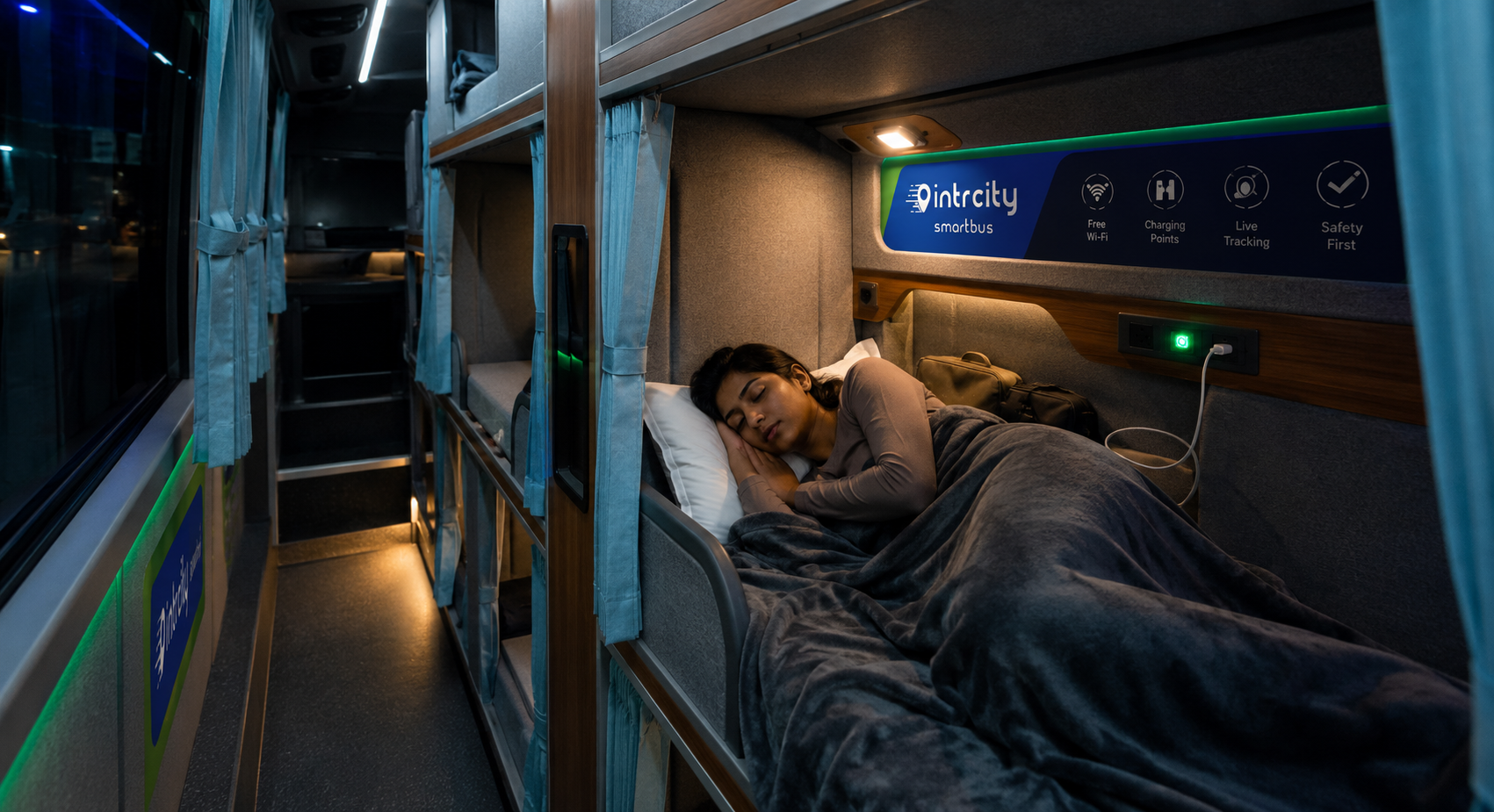

You leave the station at 9 pm. You reach at 6 am. How your day begins is generally not dictated by the bus ride but rather the preparation you did for the ride, which includes making a sleeper bus reservation in the first place.
Taking an overnight trip is one of the best methods of traveling long distances in India, as you save the cost of a hotel stay and a day, and if done well, you actually end up refreshed rather than exhausted after your trip. Here is what you need to do for that.
Before You Book: Set Yourself Up to Sleep
Choose a sleeper, not a seater, for anything over 6 hours. A flat or near-flat berth lets your body actually rest instead of just sitting upright for ten hours. On IntrCity SmartBus, the Private Sleeper option goes a step further — individual cabins instead of open berths, so you’re not sharing space, light, or noise with a stranger a foot away.
Pick your departure window carefully. The 8:30 PM–10:30 PM slot tends to work best. Earlier than that and you’re trying to fall asleep while still wide awake; later and you’re cutting your sleep window short before an early arrival.
Get your sleeper bus reservation in early enough to choose your seat, not just take what’s left. Lower berths in the middle of the bus give the smoothest ride — fewer bumps than the rear, less headlight glare and engine noise than the front. If you’re booking a day or two before travel, your options narrow fast, especially on weekend departures. Online bus booking platforms typically show a live seat map, so it’s worth comparing operators and layouts before you confirm. If you haven’t sorted your booking yet, it’s worth going through a proper pre-booking checklist so you don’t miss anything that affects comfort later — operator type, boarding point, seat layout, all of it.
What to Pack: Five Things That Actually Matter
You don’t need a full kit. You need these:
- A neck or travel pillow — keeps your head from rolling every time the bus takes a curve. Genuinely the highest-value item on this list.
- An eye mask — blocks toll-plaza lights, headlights, and the phone screen two berths over.
- Earplugs or noise-cancelling earbuds — engine hum is fine to sleep through; a co-passenger’s 4:30 AM alarm is not.
- A light shawl or hoodie — AC buses run cold, and the standard-issue blanket isn’t always enough.
- A power bank — most berths have a charging point, but treat it as backup, not guaranteed.
During the Journey: Build a Routine and Stick to It
Eat light, 2–3 hours before boarding. Heavy, fried, or very spicy food plus a bumpy highway is not a combination your stomach will thank you for. Sip water rather than gulping it — there’s nothing worse than needing a washroom break on a route with none scheduled. (One advantage of travelling with IntrCity SmartBus: several buses come with an in-built washroom, so this is less of a constraint than it is on a standard sleeper coach.)
Claim your space in the first ten minutes. Curtain shut, eye mask on, earplugs in, phone on Do Not Disturb, alarm set for 30 minutes before arrival. Don’t scroll for the first hour — screen light works against you. A podcast or audiobook with your eyes closed does a much better job of easing you into sleep.
Use the rest stop properly, then commit to sleep. Most overnight routes make one stop a couple of hours in. Stretch, use the washroom, have a chai if you want — then get back in, because the stretch right after the stop, once the bus is back on the open highway, is usually the easiest window to actually fall asleep in.
Mind your feet. Cold feet wake people up more often than almost anything else on an AC bus. Socks matter more than they sound like they should.
Picking the Right Seat for the Right Route
Not every route behaves the same way. Hill and ghat sections — Bangalore to Goa, or the climb into Manali — sway more than flat highway stretches, so a lower berth and a stable middle position matter even more here than on a straight run. This is also where your sleeper bus reservation choices start to matter more than usual — a seat that works fine on a flat highway route can feel completely different on a winding ghat section. If you’re still deciding between seat types for your specific route, this comparison of booking options for different travel styles breaks down which layout suits solo, couple, or family travel best.
How IntrCity SmartBus Supports the Overnight Journey
A few things that make this easier to get right when your bus booking is with IntrCity SmartBus:
- Private Sleeper cabins on long-haul routes, so you’re not sharing an open berth.
- Real-time tracking via the app or website, with accurate ETA updates — useful for setting that arrival alarm with confidence, and for family back home to follow along.
- Free changes after booking — date, time, bus, or seat can be modified through the app, which matters if your plans shift closer to departure.
- In-bus washroom on several routes, a real convenience for overnight travel, especially for families, children, and senior travellers.
- Hygienic, verified food stops, not random highway dhabas, if you do want a chai or light bite at the rest stop.
- An 85.4% on-time departure rate in 2025 — relevant when your entire sleep math depends on the bus actually leaving when it says it will.
Before You Go: A Short Checklist
- Test your eye mask and earplugs at home — don’t discover they’re uncomfortable at 11 PM on the highway.
- Download podcasts, music, or audiobooks in advance; network coverage drops on hill and rural stretches.
- Set two alarms — one 30 minutes before arrival, one at arrival time.
- Keep phone, wallet, and earbuds in one small pouch, tucked under your pillow or blanket, so you’re not patting yourself down half-asleep at 5 AM.
- Book a few days ahead for weekend travel; Friday and Sunday nights sell out the best berths first. If you’re newer to online bus booking generally, this first-timer’s guide to bus ticket booking is a good starting point before you get into seat-specific choices.
The Bottom Line
The bus does the driving. Your job is just to give yourself the best possible chance at sleep — right departure time, right berth, the same five-item kit every time, and a routine you run the moment you sit down. Do that consistently and the overnight bus stops being something you survive and starts being something that actually works in your favour: a full night’s distance covered, a hotel night saved, and a morning where you don’t need three coffees just to function. It really does start with a good sleeper bus reservation.
Frequently Asked Questions
Q1. How do I sleep better on an overnight bus?
Ans. Use an eye mask, earplugs, and a travel pillow, eat light before boarding, and pick a lower berth in the middle of the bus for the smoothest ride.
Q2. What should I pack for an overnight bus journey?
Ans. An eye mask, neck pillow, earplugs or earbuds, a light shawl, a power bank, a small water bottle, and a pouch for valuables.
Q3. Is a sleeper bus better than a semi-sleeper for overnight travel?
Ans. For anything over 6 hours, yes — a flat or near-flat berth gives you real rest, where a semi-sleeper only reclines.
Q4. What’s the best seat position on an overnight bus?
Ans. Lower berth, middle section of the bus — away from rear bumps and front-row engine noise and glare. Most online bus booking platforms show this on a seat map, so check before confirming your sleeper bus reservation.
Q5. Do overnight buses have charging points?
Ans. Most modern AC sleeper buses do, usually one per berth. Carry a power bank as backup regardless.
Q6. Are overnight buses safe in India?
Ans. With a reputed operator, yes. Look for real-time tracking, verified drivers, and clear safety protocols — IntrCity SmartBus, for instance, tracks every journey live via its app.
Q7. Is overnight bus travel cheaper than flying?
Ans. Usually significantly — bus fares typically run well below flight fares on comparable routes, and you also save a hotel night, which lowers the real cost further.
Q8. What’s the best departure time for overnight travel?
Ans. Generally between 8:30 PM and 10:30 PM — late enough that you’re ready to sleep, early enough to land a full night before a morning arrival.